


Pest Control Isn’t Enough. Here’s What Works Better.
By: Vincenzo Flor Oct 22, 2026Why Killing Pests Isn’t Enough: From Pest Control to Pest Management, Use The PESTE Framework to Start Managing the Problem.
Stop Treating Pests. Start Managing the Problem.
When people think about pest control, the first question is usually:
“What treatment will get rid of them?”
It is an understandable question but it often skips the more important ones.
How did the pests get there?
What is allowing them to stay?
Could something in the building or daily operations be contributing to the problem?
And after treatment, how do we know the problem has actually been brought under control?
A pesticide, trap, bait, or other treatment can be effective. But if the conditions behind the infestation remain unchanged, the pest problem can eventually return.
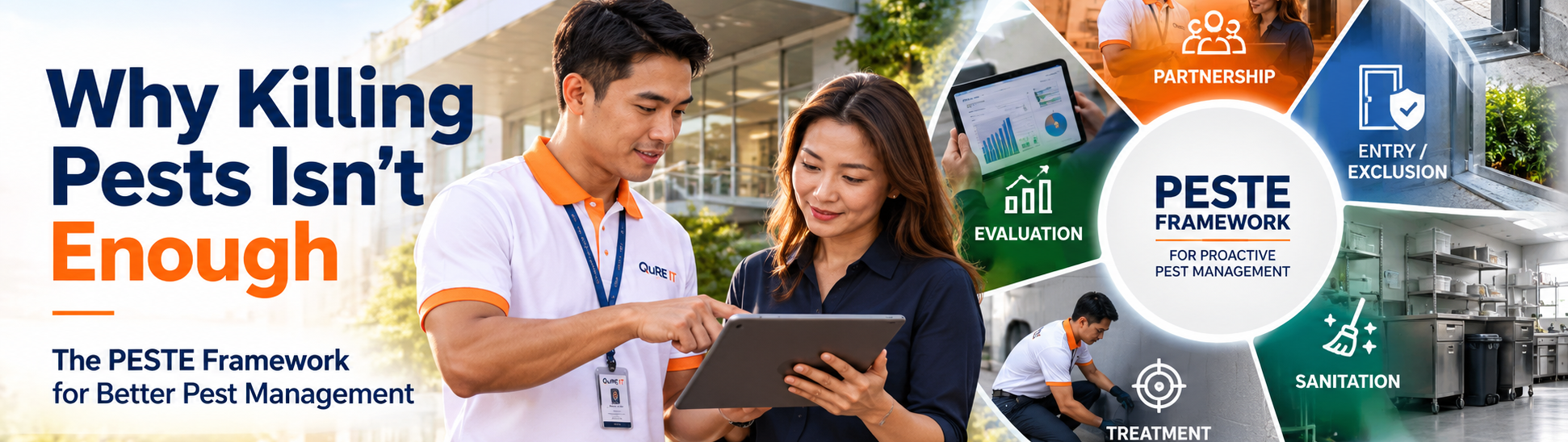
That is why we developed the P.E.S.T.E. Framework for Proactive Pest Management.
PESTE stands for:
Partnership → Entry → Sanitation → Treatment → Evaluation
It provides a simple way to look beyond the pest itself and understand the entire situation surrounding it.
-
P — Partnership
Pest management works better when responsibility is shared.
A pest management company can inspect, monitor, recommend corrective actions, and perform treatments.
But we cannot repair a client's building, change how employees store food, improve stock rotation, remove waste throughout the day, or correct every operational condition that may attract pests.
At the same time, clients cannot be expected to identify pest species, understand their behavior, or determine the appropriate treatment on their own.
Effective pest management therefore requires partnership.
The pest management provider brings technical knowledge and intervention. The client controls many of the environmental and operational conditions within the property.
The important question becomes:
Who needs to do what to solve the problem?
Clear responsibility makes pest management more effective than simply treating a site and hoping the problem does not return.
Partnership is also not just the first step. It continues throughout the entire PESTE process.
-
E — Entry
How are the pests getting in?
Before repeatedly treating pests inside a property, it makes sense to determine how they are getting there.
PESTE looks at two general possibilities.
Migrated Entry
Some pests enter on their own.
They may move through:
- gaps around doors and windows,
- cracks and openings,
- drains,
- utility penetrations,
- roof spaces,
- neighboring areas,
- landscaping,
- or other structural access points.
Where practical, these pathways should be corrected, sealed, screened, repaired, or otherwise managed.
Introduced Entry
Other pests are brought into the property.
They may arrive with:
- deliveries,
- boxes and packaging,
- raw materials,
- pallets,
- equipment,
- transferred stock,
- vehicles,
- luggage,
- plants,
- or other incoming items.
In these situations, sealing a crack will not solve the problem.
The solution may instead involve better receiving procedures, inspection of deliveries, storage practices, stock movement, or supplier controls.
Understanding how the pest arrived helps determine what needs to change.
-
S — Sanitation
What is helping the pest survive?
Sanitation in pest management means more than simply keeping an area clean.
Pests generally need some combination of:
food, water, shelter, and suitable conditions to survive and reproduce.
Those conditions can exist even in facilities that appear clean.
Examples include:
- food residues hidden beneath equipment,
- standing water or moisture,
- improperly stored materials,
- clutter,
- delayed waste removal,
- poorly managed stock,
- damaged packaging,
- drainage problems,
- inaccessible cleaning areas,
- and operational practices that repeatedly create pest-friendly conditions.
This is why spraying alone can sometimes produce disappointing long-term results.
Treatment may reduce the pest population, but if food, water, shelter, and other supporting conditions remain readily available, the environment continues to favor the pest.
Good sanitation and good operational practices make other pest management measures more effective.
-
T — Treatment
Treatment matters... but it should be the right treatment for the problem.
PESTE does not reject chemical treatment.
Pesticides remain important tools in professional pest management when they are necessary and appropriately used.
The difference is that treatment should not automatically be the first or only response.
Treatment should be based on what has been discovered during inspection and monitoring.
Depending on the pest and situation, management may involve:
- baiting,
- trapping,
- physical removal,
- exclusion,
- monitoring devices,
- biological or behavioral methods,
- chemical applications,
- or a combination of approaches.
The objective is not to use the most treatment possible.
It is to use the intervention that the situation actually requires.
Chemical treatment should support good pest management practices, not compensate indefinitely for conditions that can and should be corrected.
-
E — Evaluation
Did it actually work?
This is one of the most overlooked parts of pest management.
A service visit being completed does not automatically mean the pest problem has been solved.
After intervention, the situation has to be evaluated.
Are pests still being detected?
Has activity decreased?
Were the identified entry points corrected?
Have sanitation issues improved?
Were recommended corrective actions completed?
Are new problems appearing?
Does the treatment need adjustment?
Evaluation turns pest management into a process of measurement and improvement rather than repeated reaction.
If the results are not satisfactory, the process goes back to the relevant part of PESTE and the situation is reassessed.
-
PESTE Is a Cycle
PESTE follows a sequence:
Partnership → Entry → Sanitation → Treatment → Evaluation
But pest management does not permanently end after the last step.
Buildings change.
Operations change.
Weather changes.
People change.
Deliveries and suppliers change.
And pest pressure changes with them.
Evaluation therefore feeds back into the next cycle of pest management.
The objective is not to promise that a property will somehow remain completely pest-free forever.
The objective is to create a system capable of detecting problems early, understanding why they are happening, correcting what can be corrected, treating what needs to be treated, and checking whether the response worked.
-
A Better Question Than “What Can We Spray?”
Professional pest management should go beyond simply reacting to visible pests.
When a pest problem appears, PESTE encourages five questions:
Partnership: Who needs to take action?
Entry: How are the pests getting here?
Sanitation: What is helping them survive?
Treatment: What intervention does the situation justify?
Evaluation: Did our actions actually work?
Those questions may sound simple.
But answering them consistently changes pest control from a series of treatments into a proactive pest management system.
And that is the fundamental idea behind PESTE:
Treat the pest when necessary but manage the conditions that create the pest problem.
The PESTE Framework for Proactive Pest Management was developed by Carlo Vincenzo Jesus B. Flor III through QuRE IT Inc. as a practical framework for more systematic, accountable, and sustainable pest management.
Want to read more articles? Go back to blog homepage